
It's been a busy couple of weeks working on HAND IN HAND.
After getting the dedicated server working and starting to think seriously about actually releasing this game, I've been spending a lot of time filling out the remaining gameplay systems.
And I think we're getting somewhere.
Up until now, most of my attention has been on the fundamentals.
Roads, zoning, electricity, water, jobs, taxes, emergency services, and getting our municipalities to work together.
All the things you need to make a city function.
But there's a difference between a city that functions and one that actually feels like somewhere people would want to live.
So I've been working on two major areas.
Culture and transportation.
And what started as adding a few extra buildings has turned into a pretty substantial expansion of the game.
A City Needs More Than Houses and Factories
When I first started developing the game, my main focus was getting buildings to grow and making sure citizens had the basic services they needed.
But as our test cities got bigger, I started thinking about what would make different neighbourhoods more desirable.
Why would somebody want to live in one part of town instead of another?
What makes a small village different from a large city?
And what gives a mayor something interesting to build after they've already got the basics working?
Culture seemed like a good place to start.
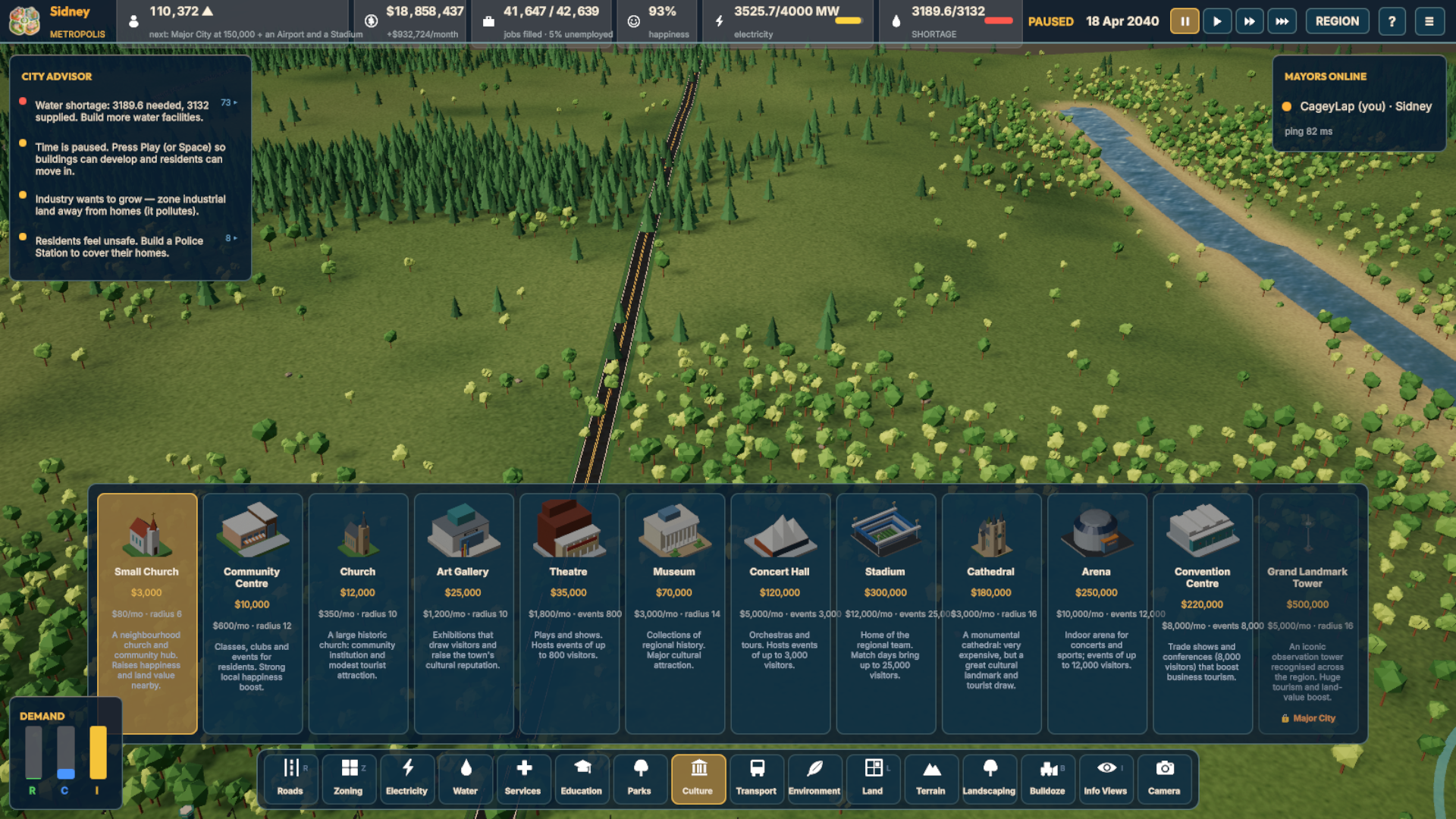
So I've spent the last week developing what I think is now the final list of cultural buildings for the game.
There are twelve of them, ranging from a little neighbourhood church all the way up to a massive landmark tower.
And they aren't all available from the beginning.
Starting Small
When you first start a municipality, you don't have access to a huge collection of cultural buildings.
You need to grow your town first.
Once you reach Village status at 500 residents, you unlock your first cultural building.
A Small Church.
It doesn't do anything especially elaborate, but it provides a happiness benefit to the surrounding neighbourhood.
And that's important because happiness is one of the biggest factors influencing how buildings develop.
As your town advances, more options become available.
Next comes the Community Centre.
Then the larger Church and the Art Gallery.
And as you continue growing, you start unlocking buildings like the Theatre, Museum, Concert Hall, Stadium, Cathedral, Arena, Convention Centre, and eventually the Grand Landmark Tower.
Each new stage of development gives you more ways to improve the city.
And that's the part I like.
Instead of giving players everything right from the beginning, the city gradually gains access to more sophisticated facilities as it becomes large enough to support them.
Happiness, Land Value, and Tourism
The first cultural buildings mainly provide happiness bonuses within a surrounding coverage area.
Build a community centre near your residential neighbourhoods, for example, and those nearby buildings benefit.
But as I've been developing the larger cultural buildings, I've started adding other effects.
Land value is one of them.
Putting cultural facilities near residential and commercial areas can make those neighbourhoods more desirable.
That helps support growth and makes cultural buildings useful beyond simply checking another happiness requirement.
Then I started thinking about tourism.
An Art Gallery shouldn't just make nearby residents happier.
It should also be something that attracts visitors.
The same goes for theatres, museums, concert halls, stadiums, and other major attractions.
So I've been developing a tourism system that allows cultural buildings to attract visitors and generate revenue for the municipality.
It's another way for towns to develop their economies without relying entirely on residential, commercial, and industrial taxes.
And it gives players a reason to think about what kind of city they're building.
Let's Put on a Show!
One of the more interesting additions has been events.
Theatres, concert halls, stadiums, and other venues can host events that attract visitors.
So instead of these buildings simply sitting there providing a permanent happiness bonus, they can also create bursts of activity.
A theatre puts on a show.
A concert hall hosts an event.
A stadium brings in a large crowd.
That creates an influx of visitors and gives the city another way to generate tourism revenue.
It's a relatively simple mechanic, but I think it adds something important.
The city feels a little less static.
Things are happening.
And as I've been discovering with traffic and emergency vehicles, those little signs of activity go a long way toward making a city feel alive.
Culture Isn't Free
Of course, all of this comes with a catch.
These buildings cost money.
Not just to build, but to maintain.
I've been working on the financial system recently, and I wanted cultural facilities to fit into that rather than simply being free happiness generators.
Take the Museum, for example.
It costs $70,000 to build.
Then you're paying another $3,000 every month to keep it operating.
And the bigger facilities can become considerably more expensive.
That means you can't just place every cultural building you've unlocked and assume everything will be fine.
Well, you can try.
But your treasury might have something to say about it.
I want culture to be valuable, but I also want players to think about whether their town can afford the facilities they're building.
A large city might have no trouble maintaining a museum, theatre, and concert hall.
A little village probably shouldn't be trying to fund an enormous stadium.
At least, not unless the mayor has a particularly interesting financial strategy!
Now We Need to Move Everybody Around
The other major system I've been expanding is transportation.
Originally, I had a fairly small list of ideas.
A Bus Depot.
A Train Station.
A Cargo Port and Shipyard.
And eventually an Airport.
The general idea was to give players ways to move people and goods while reducing the amount of traffic on the roads.
As I've been developing and testing the game, though, that list has grown quite a bit.
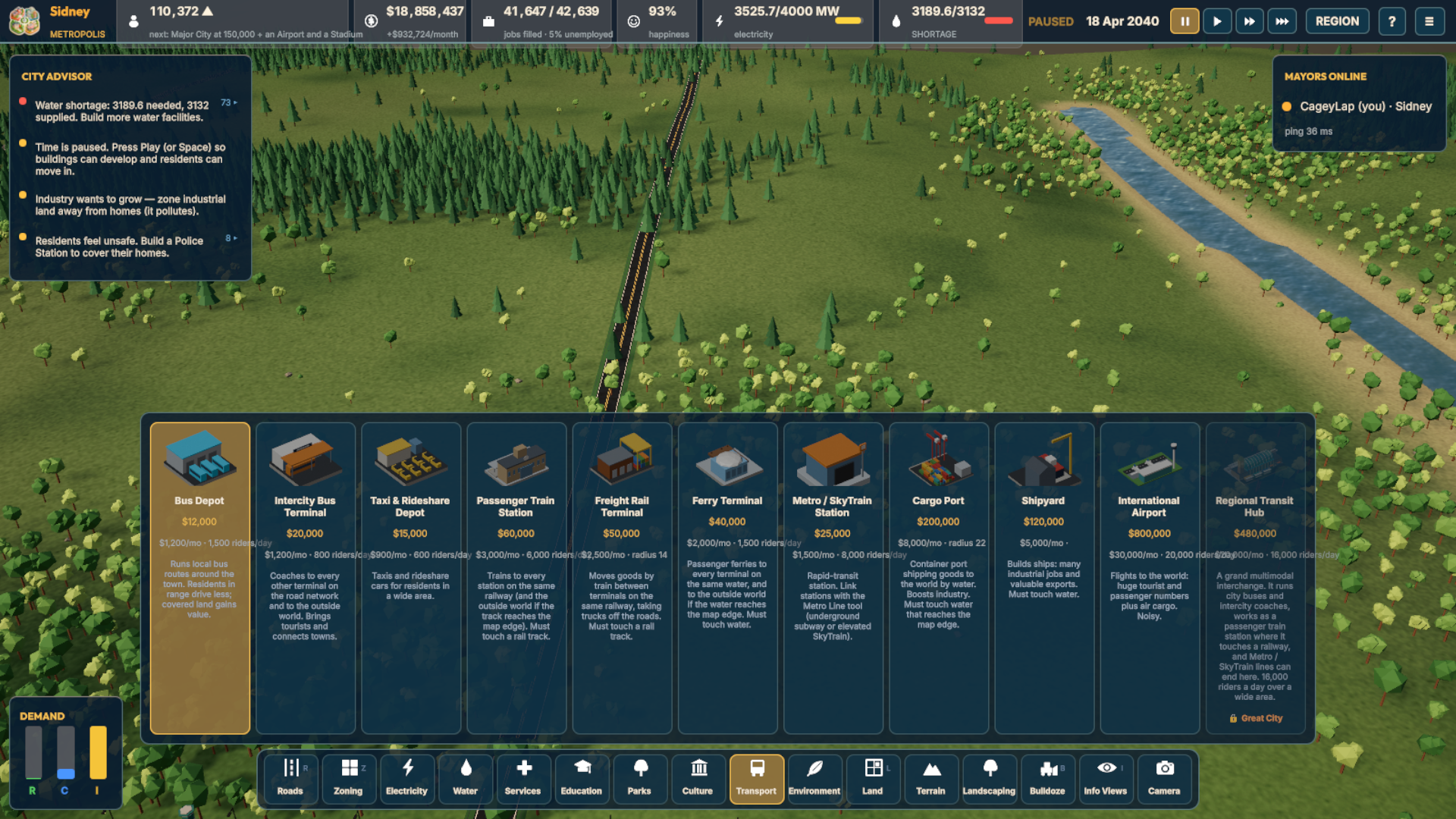
We've now settled on eleven different transportation facilities.
And just like culture, they're unlocked as your municipality grows.
Buses, Taxis, and Getting Cars Off the Road
The first transportation option is the Bus Depot.
The idea is to have buses running routes between stations, providing public transportation and reducing regular vehicle traffic around the areas they serve.
It's a way to help manage congestion without forcing players to build increasingly complicated road networks.
I've also added an Intercity Bus Terminal.
That opens up the possibility of passengers travelling between towns, including visitors coming into your municipality from elsewhere in the region.
Which connects nicely to the new tourism system.
Then there's the Taxi and Rideshare Depot.
That provides another local transportation option, helping reduce traffic within its service area.
I've been developing formulas for how much these facilities reduce congestion, depending on their coverage and the number of people they can serve.
The goal isn't to eliminate traffic entirely.
It's to give mayors useful ways to manage it.
All Aboard!
Next up is rail.
Originally, I was mostly thinking about freight trains.
Industry needs to move goods, and trains seemed like a natural way to handle larger amounts of cargo.
So I started with a freight terminal.
But then I thought, why stop there?
People need to travel too.
So I've now added a Passenger Train Station as well.
The idea is that passenger trains can move people between connected locations, while freight trains help industry move goods through the region.
That gives transportation two different purposes.
Moving people and moving cargo.
And both can have their own effects on the city's economy and road traffic.
A Little West Coast Influence
Living on the West Coast, there's another form of transportation that's a pretty familiar part of everyday life.
Ferries.
Once I started working on cargo ships and ports, it seemed obvious that passenger ferries should be part of the game too.
So I've added a Ferry Terminal.
Players can place terminals along the water and connect them with ferry service.
That creates another way for people to travel between different locations without using the road network.
And it gives rivers and waterways a more meaningful role in how a region develops.
It's also one more reason I need to make sure those bridges I've been working on have enough clearance underneath them!
Going Underground... Or Above It
I've also been working on a Metro and SkyTrain system.
Here in Vancouver, we have the SkyTrain, which runs above ground through much of the region.
It's basically our version of rapid transit, and I thought it would be interesting to give players a similar option.
So I've developed the idea of connected metro stations with either underground subway tracks or elevated SkyTrain-style tracks.
The stations provide a traffic-reduction benefit around the areas they serve.
This should become particularly useful as towns grow into larger cities and road congestion becomes harder to manage.
It's another way to add complexity to the transportation simulation without necessarily making the basic road-building system more complicated.
Ports, Airports, and the Big Stuff
At the larger end of the transportation system, we've got the Cargo Port, Shipyard, and International Airport.
Ports and shipyards support shipping and industry.
The Airport introduces another major source of visitors and tourism.
And all of them provide additional opportunities for revenue as the city becomes more developed.
Then there's the final major transportation unlock.
The Regional Transit Hub.
This is the big one.
A major facility intended for the later stages of city development, combining different transportation services and providing substantial benefits to the surrounding city.
It's the sort of thing a small town wouldn't even dream of building.
But once you've got a large municipality with the money and population to support it, it becomes another major goal to work toward.
A New Reason to Balance the Budget
There's one other little mechanic I've added that came from a suggestion by one of my friends during testing.
And I think it's a good one.
We've already got monthly income and expenses.
Taxes bring money in.
Services, culture, transportation, and infrastructure cost money to operate.
But what happens if your town starts running at a deficit?
Previously, the biggest consequence was simply watching your treasury go down.
Now there's another problem.
If your municipality runs a monthly deficit, service coverage is reduced by 60%.
Fire protection, healthcare, cultural services, and other coverage-based systems become much less effective.
The idea is that if the city can't afford to fund its services properly, those services shouldn't operate at full capacity.
That has some pretty interesting consequences.
Maybe you've built a beautiful city full of cultural attractions.
But if you can't afford to maintain them, the people living nearby aren't going to receive the same benefits.
And if your emergency services lose coverage, that could affect happiness and development too.
It's a relatively simple rule, but it makes the budget much more important.
You can no longer ignore a deficit just because you've got a little money left in the bank.
And I like that.
It makes the economy feel connected to the rest of the game.
Is the Gameplay System Finally Coming Together?
After a couple of weeks of testing and adding all these new buildings, I'm starting to feel like the main gameplay systems are getting close to where I want them.
We've now got zoning, growth, services, education, culture, transportation, tourism, trading, finances, land ownership, and cooperative municipalities.
The systems are starting to influence one another in ways that make the game much more interesting.
Build a cultural attraction and you can improve happiness, land value, and tourism.
Add transportation and you can reduce traffic while moving passengers and freight.
But all of those facilities cost money.
And if your finances fall apart, your services suffer.
That's exactly the kind of interconnected gameplay I've been trying to build.
The biggest challenge now is balancing everything.
Is it too easy to make money?
Are some buildings too expensive?
Do certain facilities provide too much benefit?
Are the unlocks happening at the right population levels?
Those are the sorts of things I'll be spending more time testing and adjusting.
But for the first time, I'm starting to feel like the foundation of the actual game is nearly complete.
There'll always be more features I could add.
And I'm sure I'll come up with plenty more ideas along the way.
But I think we're getting close to the point where I need to stop adding major gameplay systems and start concentrating on making everything work together properly.
The city is growing up. Now I just need to make sure it can afford to!