
Today feels like a pretty big day for HAND IN HAND.
Actually, I think it might be the biggest day since I started working on this game.
Something has changed over the last couple of days, and for the first time, I'm seriously wondering whether this little project I've been building for my friends could actually become a game that other people might want to buy.
And strangely enough, it all started with a server.
Remember Why We Started This?
A few months ago, Kevin and I were talking about finding another cooperative game we could play together.
We've spent years playing games with friends, and some of our favourites have been games like Exile, the multiplayer survival mod for Arma.
And the funny thing about those games is that, even though they're technically shooting games, we often spent more time building our bases than actually shooting anything.
We liked building things together.
Planning something, gathering what we needed, and then watching it take shape.
So we started talking about how much fun it would be to have a proper cooperative city-building game.
Not just two people building separate cities and comparing scores.
A game where friends could actually build a city together.
There didn't seem to be much out there that did what we were looking for.
And eventually I started thinking...
Could I build something like that myself?
I'd never really intended for this to become a commercial game.
It was just something I wanted to try.
Something for Kevin and me to play, and hopefully something the rest of our friends would enjoy too.
Well, here we are a few months later.
And things have gotten a little out of hand.
The Problem With Hosting a Game
Up until now, multiplayer in HAND IN HAND has worked much like a lot of other cooperative games.
One person hosts the game on their computer.
Everyone else connects to that player, and we build our region together.
It's worked well enough for testing.
We've created towns, grown cities, traded land, and even merged our municipalities into larger cities.
But there's one pretty significant limitation.
The person hosting the game has to be online.
If Kevin wants to jump into our region and work on his town, but I'm the one hosting it, he can't just open the game and start building.
He needs me to be available.
Which generally means getting on Discord, checking who's around, figuring out who's hosting, and arranging to start the game.
And when the host shuts the game down, that's it.
Everybody's done until the next session.
For a few friends testing something together, that's manageable.
But the more we've been playing, the more I've started realizing that this really isn't how I want HAND IN HAND to work.
A city-building game is something you might want to sit down and play for twenty minutes.
Or two hours.
Or spend an entire evening working on.
You shouldn't need to arrange a multiplayer session every time you want to add a few streets to your town.
What If the Region Never Had to Close?
A couple of days ago, I started experimenting with a different idea.
What if the game ran on its own dedicated server?
Not a copy of the game running on somebody's desktop, with a player acting as the host.
A separate, headless server running the simulation and managing the regions.
Players would connect to the server instead of directly to another player's game.
And when a player disconnected, the region would still be there.
Another mayor could log in later and continue building.
Nobody would need to call the host first.
Nobody would need to wait for everyone else to be available.
The server would handle the world, and players could come and go whenever they had time.
That sounded like a much better way to build a cooperative city.
So I decided to see if I could make it work.
Forty-Eight Hours Later...
We have a working dedicated server!
I've spent the last couple of days building the first headless server version of HAND IN HAND.
It's running on Windows, and instead of needing one of the players to host a region, the server manages the games.
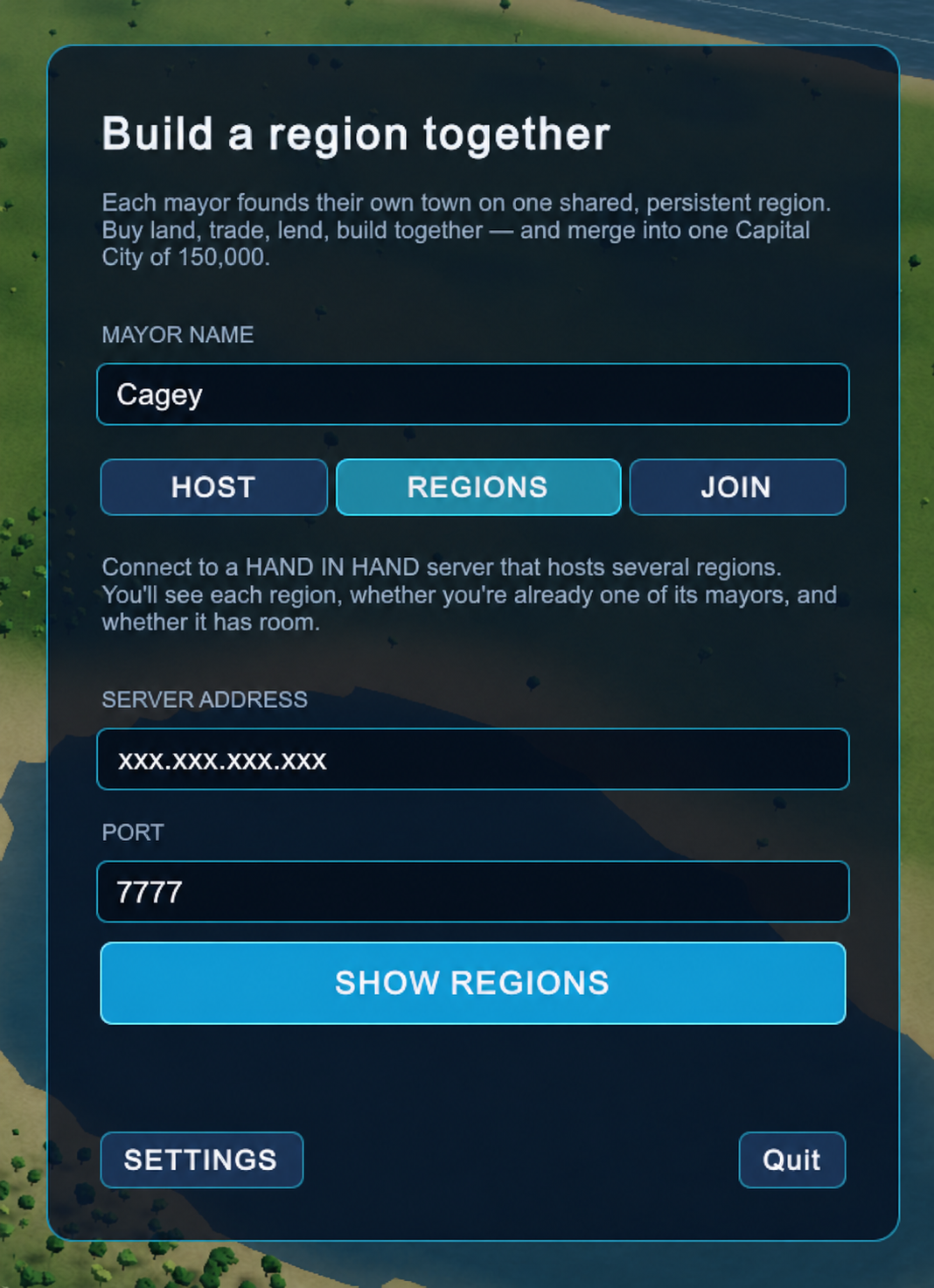
I've also put together a new lobby for connecting to it.
Players enter the server address, connect, and can see the regions available on that server.
From there, they can join a region and start playing.
And when they're finished, they can leave.
The other players don't need to leave with them.
They can carry on building, or come back later when they've got some free time.
We tested it over the last forty-eight hours, and it's working.
And I have to say, it changes the whole experience.
Play When You Want to Play
The difference is almost hard to explain until you've actually played it.
Previously, getting everybody into a region was a bit of an event.
Who's hosting tonight?
Is everyone ready?
Can we get everybody connected?
Now somebody can simply jump in, work on their town, and log out.
Another player might come along later and find that a new neighbourhood has appeared.
Or that somebody has expanded their roads closer to the municipal boundary.
Maybe one of the other mayors has been working on a commercial district while everyone else was away.
The region feels less like a multiplayer session and more like an actual place that everybody shares.
And for the sort of game I'm trying to build, that's a pretty important distinction.
HAND IN HAND is about building independently and eventually coming together.
Having a world that doesn't depend on everybody being online at the same time makes that idea much more practical.
It also means the game can fit into people's schedules instead of requiring everybody to make the same schedule work.
And judging by the reaction from my friends, I'm not the only one who thinks this is a big improvement.
"You Need to Sell This Game!"
Here's the part I wasn't expecting.
Over the last two days, as we've been testing the new server setup, the conversation with my friends has started to change.
Instead of just talking about bugs, new buildings, or what feature I should work on next, they've started saying something else.
"You need to sell this game!"
And not just one person saying it once.
The general reaction has been that this is something other people would probably enjoy playing too.
That there's a real idea here.
A cooperative city builder where friends can have their own municipalities, develop them independently, trade with one another, and eventually bring their cities together.
And now, with the dedicated server, they don't even have to arrange to play at the same time.
I've been so busy building the thing that I haven't really spent much time thinking about it that way.
For me, it's been a project.
Something I wanted to see if I could make work.
But after the last forty-eight hours, I'm starting to wonder whether maybe they're right.
Maybe this could actually be a game worth releasing.
Suddenly, I'm Thinking About Steam
So this is where things are getting interesting.
For the first time, I'm seriously considering the idea of releasing HAND IN HAND commercially.
Maybe putting it on Steam.
Maybe opening it up so people outside our little group can play.
And once I start thinking about that, a whole bunch of other questions come along with it.
Is the game stable enough?
What needs to be finished before other people can play it?
How would I distribute the dedicated server?
What about players who use Macs?
Could I eventually build a Mac client too?
How much more work would it take to turn what I've built into something I could actually release?
I don't have answers to all of those questions yet.
In fact, I probably have more questions than answers right now.
But that's okay.
Because for the first time, I'm thinking about HAND IN HAND as something bigger than a game for me and my friends.
Time to Make a Roadmap
I think my next step is going to be sitting down and putting together a proper development roadmap.
Up until now, I've mostly been working on whatever feature or problem seemed most important at the time.
And to be fair, that's been a lot of fun.
It's also how we've ended up with everything from municipal mergers and land trading to fire trucks and working bridges.
But if I'm actually going to try to release this game, I'll need to start thinking a little differently.
What absolutely needs to work?
What needs more testing?
What's essential for a first release, and what can wait until later?
And just how much work am I willing to take on?
I don't know yet whether this is going to turn into something I can actually sell.
Maybe we'll put it out there and nobody will be interested.
Or maybe there are other people who've been looking for exactly the same kind of cooperative city-building game Kevin and I wanted in the first place.
I suppose there's only one way to find out.
A Different Kind of Beginning
When I started HAND IN HAND, I wanted to make a game that I could play with my friends.
That hasn't changed.
I still want that.
But over the last couple of days, something has shifted.
We now have a working standalone server.
Our regions no longer depend on one person hosting the game.
Players can come and go when they want.
And my friends are telling me that maybe it's time to think about sharing this with everyone else.
So today, August 1, 2026, I'm going to start looking seriously at what it would take to turn HAND IN HAND into a game I can release.
I don't know where this is going to lead.
But I'm pretty excited to find out.
What started as a game for a few friends might just become something much bigger.