
There's something I've been discovering while developing HAND IN HAND.
It's surprisingly easy to make a city look successful.
Build a bunch of houses, add some businesses, throw in a few factories, and before long you've got thousands of people living in a pretty impressive-looking town.
But there's one rather important question I've been spending some time trying to answer.
Who's paying for all of this?
I've been working on the financial side of the game, and what started as a fairly simple tax system is quickly becoming something much bigger.
Because apparently, running a city costs money.
Who knew?
Three Tax Rates and a Dream
When I first put together the financial system, I wanted to keep things straightforward.
HAND IN HAND has three basic zoning categories: Residential, Commercial, and Industrial.
So naturally, those became the three sources of tax revenue.
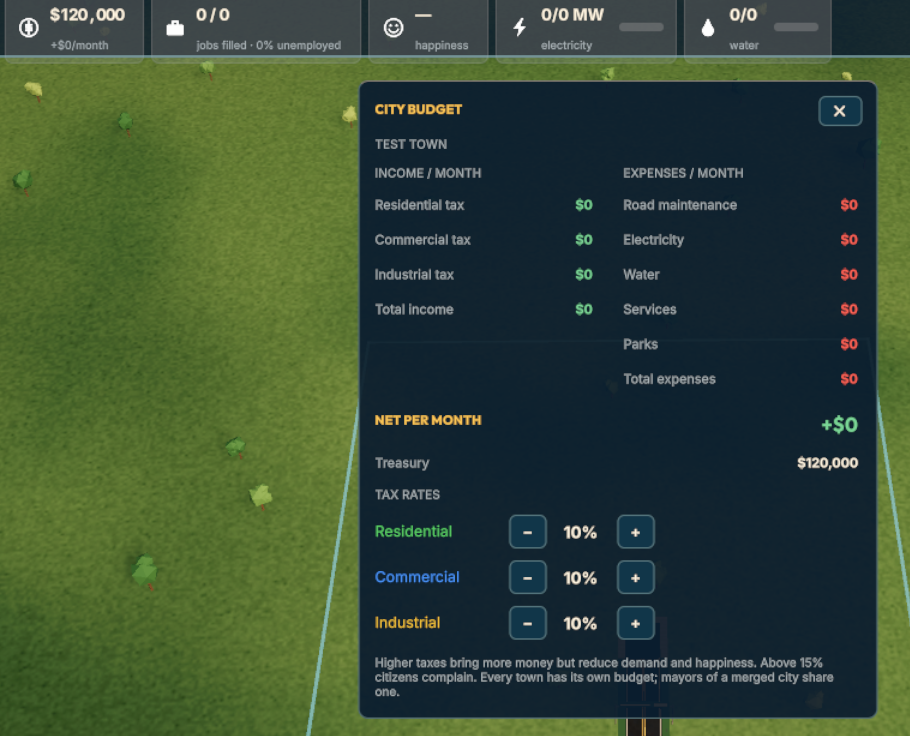
Every town starts with $120,000 in its treasury, and each zoning category has its own adjustable tax rate.
The default is 10%.
Build residential neighbourhoods, collect residential taxes.
Develop commercial properties, collect commercial taxes.
Add industry, collect industrial taxes.
Simple enough.
Want to make more money?
Raise taxes.
Want to encourage development?
Lower them.
At least, that was the initial idea.
But as I started developing larger cities and adding more services, I realized there was a fairly obvious problem with this approach.
The city was making money, but it wasn't really spending much of it.
Somebody Has to Pay the Bills
Every time I add another service building, I'm creating something that should have an ongoing cost.
Fire stations need funding.
Police stations need funding.
Schools, parks, electricity, water infrastructure, and transportation all cost money to operate.
And as buildings become larger or more advanced, those expenses should increase.
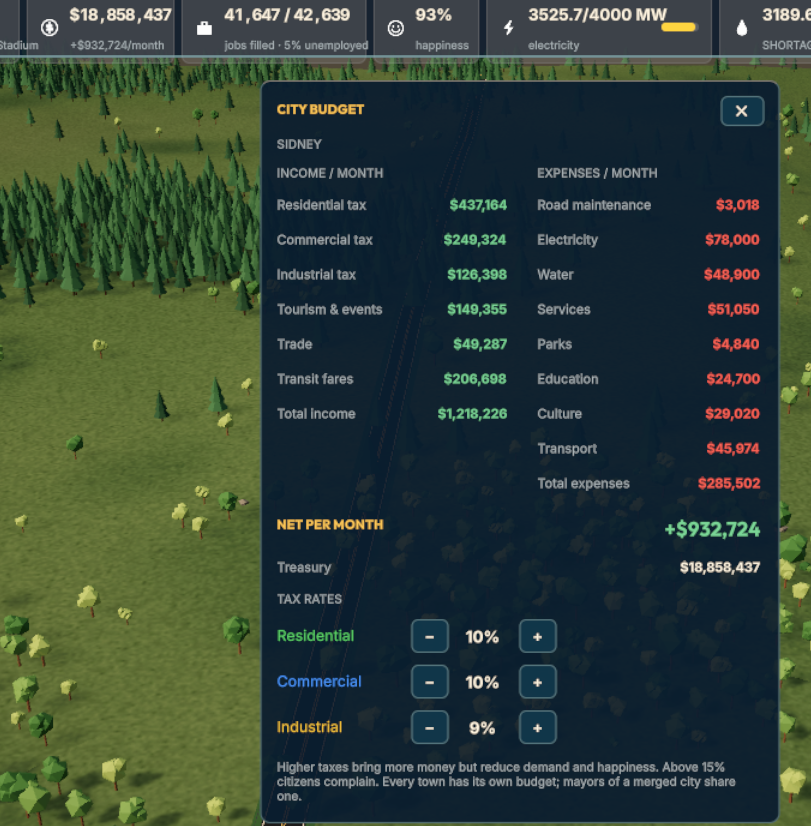
So I've started building a more complete municipal budget system.
Instead of just tracking the money coming in from taxes, the game now needs to account for what's going out every month.
Road maintenance, electricity, water, city services, parks, and other facilities all contribute to the expenses.
The idea is that every service or building a player places has an associated operating cost.
Build a larger city, and you'll have a larger tax base.
But you'll also have considerably more bills to pay.
Now we're getting somewhere.
The Taxman Cometh
Of course, if the player can adjust tax rates, there needs to be a reason not to simply crank everything up and watch the money roll in.
And this is where the happiness system comes into play.
Citizen happiness is already one of the most important factors affecting how neighbourhoods grow.
So I've connected the tax system directly to happiness and development.
The three zoning categories each have their own adjustable tax rates.
Raise residential taxes, and residential growth can suffer.
Raise commercial taxes, and businesses become less enthusiastic about developing.
The same applies to industry.
I've also introduced an important threshold.
15% tax is where citizens really start complaining.
You can raise taxes above that level, but you're going to pay for it in happiness.
And there's another wrinkle.
Not All Buildings React the Same Way
One of the things I've been experimenting with is how tax rates affect buildings at different development levels.
A small Level 1 residential neighbourhood shouldn't necessarily react the same way as a well-established Level 3 development.
So I've been working with a sliding scale.
Lower-level buildings are more sensitive to changes in tax rates.
If you've got a new town full of Level 1 properties and decide to raise taxes to 12%, 13%, or 14%, you'll bring in a little more money from the buildings you've already got.
But you can also slow future growth considerably.
Larger, more established developments are less sensitive to those same increases.
On the other hand, drop the tax rate below the default 10%, and you can encourage development to move along more quickly.
So now there's an interesting choice.
Do you raise taxes to bring in more money today?
Or do you keep taxes low, encourage growth, and hope that a larger population and more developed properties will generate greater revenue later?
That's the sort of decision I want players to have to think about.
Watching What the City Wants
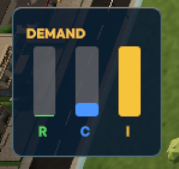
I've also added a small demand display to the main game interface.
It shows three bars representing Residential, Commercial, and Industrial demand.
R, C, and I.
It's a simple visual indicator, but I think it's an important addition.
Instead of guessing which type of zoning your town needs, you can keep an eye on the demand bars and see where the pressure for development is building.
And because taxes and happiness influence growth, players now have another way to see how their decisions affect their town.
If residential demand is strong, maybe it's time to expand your neighbourhoods.
If industrial demand is climbing, perhaps the city needs more factories and jobs.
But if you've raised taxes too aggressively, you might find that development isn't moving quite as quickly as you'd hoped.
I'm still working on the balance between all of these systems, but I like how they're beginning to connect.
More Than Just Taxes
The other interesting part of HAND IN HAND's economy is that we're not building cities completely alone.
Each mayor starts with their own municipality and their own finances.
And since players can eventually work together, trade, and merge their towns, money can move between municipalities in several ways.
I've already added the ability for players to put land up for sale and sell it to other mayors.
That's another way to bring money into your treasury.
We've also got the financial arrangements I introduced with the Region Menu.
Mayors can lend money to one another and collect interest.
And if a town has excess electricity, it can sell that power to another municipality in 5 MW blocks.
That means money isn't just about collecting taxes and paying your own expenses.
It can also become part of how players cooperate.
One mayor might have a booming industrial economy and plenty of cash.
Another might be struggling to fund the services needed to develop their town.
Being able to make deals, sell land, or borrow money gives them some interesting options.
And once municipalities merge, they'll need to manage a shared budget.
The Hardest Part Is Making It Hard Enough
One thing that's becoming pretty obvious as I test all these systems is that getting the balance right is going to take some time.
My friends have been helping me test different situations, and I'm constantly making adjustments to see what feels right.
Interestingly, most of my early balancing problems seem to go in the same direction.
Things are too easy!
I introduce a new system, we start building a city, and before long somebody has more money than they know what to do with.
So I tweak the numbers.
Increase a cost here.
Adjust a growth requirement there.
Change how much tax revenue a building generates.
Then we test it again.
I've had surprisingly few situations where something was so difficult that we simply couldn't progress.
Usually, the challenge is figuring out how to make the player work a little harder without turning the game into a frustrating grind.
I don't want HAND IN HAND to become an accounting simulator.
But I do want building and maintaining a successful city to feel like an accomplishment.
There's a balance in there somewhere.
We just need to find it.
Back to the Budget
The financial system is still going through a lot of adjustments.
I'm building out the operating costs for services and buildings, tying taxes more closely to happiness and development, and experimenting with how the whole economy behaves as towns grow.
There's also plenty more testing to do with multiplayer finances, loans, land sales, and power trading.
Over the next week, I'll be adjusting the numbers and seeing what feels right.
Too much money? We'll make things a little harder.
Not enough money? We'll figure out why.
That's becoming a pretty familiar part of game development.
Build something, test it, discover it's unbalanced, and start adjusting.
But I think the foundation is coming together.
The goal isn't just to build the biggest city.
It's to build a city that can actually afford to keep running.
Here's to the new financial system. Ever forward!