
I've spent a lot of time over the last couple of weeks working on the progression system in HAND IN HAND.
Now that I've got most of the major gameplay systems figured out, along with the buildings and services I want players to have available, there's another pretty important question to answer.
When should players actually get access to all this stuff?
It's one thing to have a bunch of buildings, transportation systems, cultural facilities, and city services.
It's another thing entirely to decide when they should become available.
Unlock everything too quickly, and there's not much left to work toward.
Make everything too difficult, and players spend hours waiting for the next milestone.
So I've been doing a lot of testing, changing population requirements, moving building unlocks around, and trying to find the right balance.
And I've made one fairly major change to the game's ultimate goal.
A Million People? Maybe Not.
When I originally started thinking about the final objective for HAND IN HAND, I had a number in my head.
One million residents.
That was going to be the target for reaching Capital City and winning the game.
It sounded like a good number.
A million people! That's a proper city!
But then we started actually playing.
And playing.
And playing some more.
Over the last couple of weeks, we've been running longer multiplayer tests, building towns, growing populations, developing infrastructure, and eventually merging municipalities.
And something became pretty obvious.
One million people is a LOT of people.
We're generally reaching somewhere between 200,000 and 300,000 residents after about 14 to 18 hours of gameplay.
And that already represents a pretty substantial amount of time spent developing a region.
If I kept the original one-million-person goal, we could be looking at a very long road to victory.
I want HAND IN HAND to be challenging, but I also want people to feel like they're making meaningful progress.
So I've decided to bring that final population target down.
Capital City will now require 300,000 residents.
That feels much more reasonable based on the testing we've done so far.
Of course, I'll keep testing it and see how it feels over the next few weeks.
But right now, I think we're getting much closer to the right balance.
Winning Means Coming Together
There's another important part of reaching Capital City.
The population target isn't enough on its own.
Remember, HAND IN HAND is about building your own municipality and eventually joining together with your friends.
So for a multiplayer region to reach Capital City, all the participating municipalities have to merge into one city.
You can grow a massive town on your own.
You can trade, expand, build infrastructure, and develop your economy.
But if you want to achieve that final Capital City victory, everybody has to come together.
I really like that.
It ties the victory condition directly into the reason I started building this game in the first place.
And if players don't want to merge?
That's fine too.
They can keep playing, developing their municipalities, and enjoying the region without necessarily chasing the final victory.
Even after reaching Capital City, the game doesn't end.
You can continue building.
The victory is a milestone, not a shutdown screen.
Making Every Advancement Worth Something
One of the things I decided fairly early in this latest round of testing was that advancing to a new city level should always feel rewarding.
Not just because you've unlocked another building.
I wanted something more immediate.
So I've introduced Free Land Deeds as part of milestone progression.
Every time your municipality advances to a new growth level, you earn another free deed for a parcel of land.
And that can be a pretty big deal.
Land isn't necessarily cheap in HAND IN HAND.
Because property values change as the region develops, a parcel might cost $30,000, $50,000, $70,000, or even $80,000 depending on where it is and what's around it.
That's money a growing municipality might need for electricity, water, education, or other services.
Giving the player a free parcel when they reach another milestone helps keep the game moving.
Instead of finally unlocking a bunch of new facilities and then discovering you can't afford anywhere to put them, you've got an opportunity to expand.
We've been testing this, and so far I think it's working really well.
It's a nice little reward for developing your town.
And it makes each new city level feel like an event worth celebrating.
Finding the Right Progression
The next challenge has been deciding exactly where all the population milestones should fall.
I've gone through the list several times now, moving things around as we've been playing.
Sometimes it's just a matter of realizing that a building needs to become available earlier.
Other times, it's finding that a population requirement is simply too high for the point in the game where a player needs a particular service.
One example is City level.
I originally had that sitting at 40,000 residents.
After testing, I moved it down to 30,000.
Not because 40,000 was necessarily impossible, but because 30,000 felt like a better place to introduce the next set of buildings and gameplay systems.
That's really what a lot of this process has been.
Build something.
Play it.
Discover that it feels a little too easy or too difficult.
Change the numbers.
Play it again.
And repeat.
More Than Just Population
I've also decided that some of the larger milestones should require more than simply reaching a certain number of residents.
As your city grows, it should need the infrastructure to support that growth.
So I've introduced additional requirements for some of the later levels.
Small City requires a High School.
Large City requires a University.
Metropolis requires train and metro transportation.
Major City requires an Airport and a Stadium.
I think this makes the progression much more interesting.
You can't just concentrate on building residential zones and expect everything else to unlock automatically.
You need to develop the city properly.
Education, transportation, culture, and major infrastructure all become part of advancing.
And since those facilities have construction costs and monthly expenses, there's another layer of financial planning involved.
The New Road to Capital City
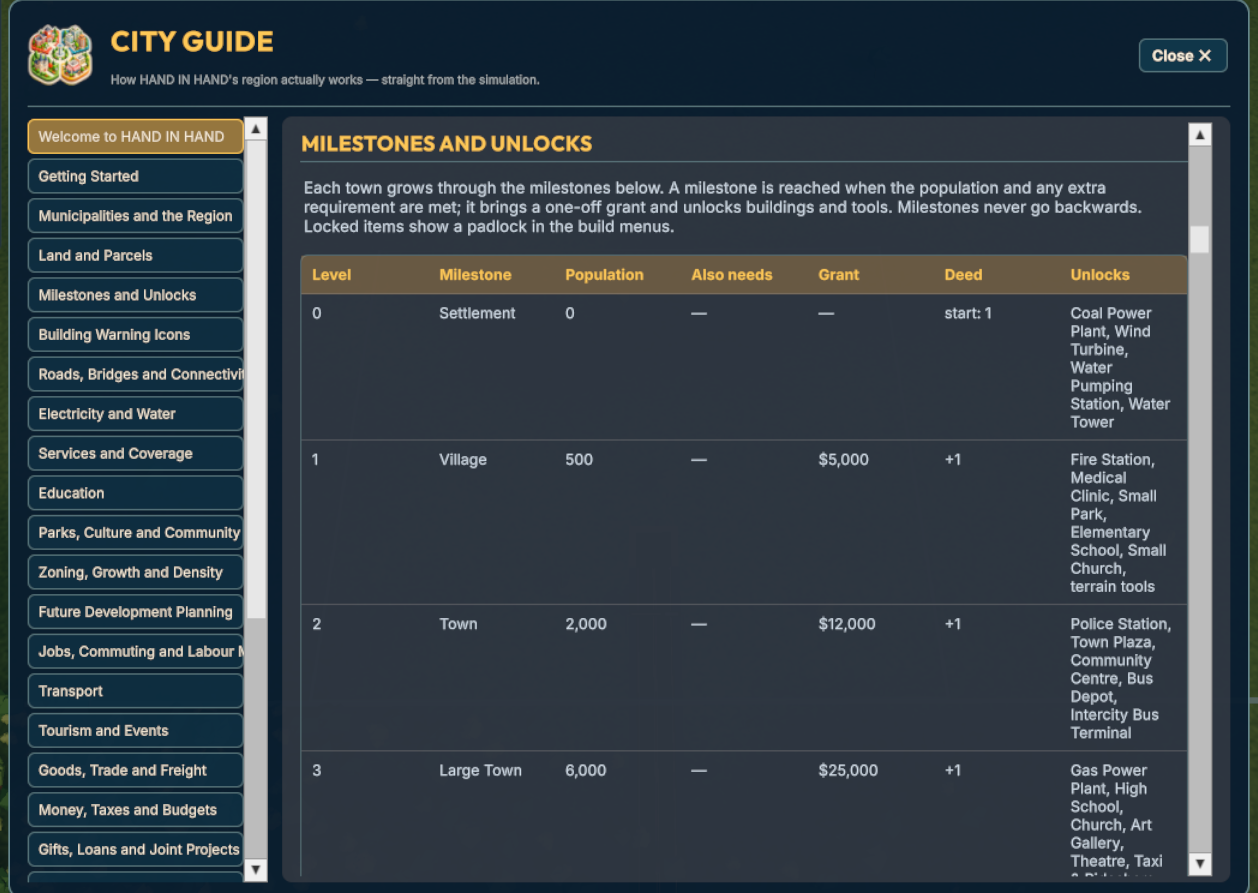
After all this testing and adjusting, here's the progression I've settled on:
| Level | Classification | Population | Additional requirement |
|---|---|---|---|
| 0 | Settlement | 0 | None |
| 1 | Village | 500 | None |
| 2 | Town | 2,000 | None |
| 3 | Large Town | 6,000 | None |
| 4 | Small City | 15,000 | High School |
| 5 | City | 30,000 | None |
| 6 | Large City | 50,000 | University |
| 7 | Metropolis | 100,000 | Train Station and Metro Station |
| 8 | Major City | 150,000 | Airport and Stadium |
| 9 | Great City | 200,000 | None |
| 10 | Capital City | 300,000 | All participating municipalities united |
Along with the population requirements, each level unlocks new buildings and systems.
There's also a one-time cash grant at each growth milestone and Free Land Deeds to help players expand.
The later levels introduce the biggest buildings and the most advanced infrastructure, giving players new goals as their municipalities develop.
And eventually, everything leads toward that 300,000-resident Capital City.
How Long Should a Game Take?
This is probably the biggest question I've been trying to answer.
I don't necessarily want HAND IN HAND to be a game somebody can finish in a couple of hours.
There's a lot to build, and the whole idea is that friends can spend time developing their own towns before eventually working together.
But I also don't want the final goal to be so far away that people never seriously consider reaching it.
Based on what we've been testing, that 14-to-18-hour range gives me a useful reference point.
It's not a fixed target or a promise that every game will take that long.
Different players will build differently.
Some will focus on growth.
Others will spend more time planning their roads, developing their neighbourhoods, and making their towns look the way they want.
But having real testing experience to work from is much better than picking a number because it sounds impressive.
Which, if I'm being fair, is pretty much how I arrived at one million in the first place!
Are We There Yet?
I'm feeling pretty good about where the progression system is now.
The levels are spaced out more naturally.
The building unlocks make more sense.
The additional requirements encourage players to develop complete cities rather than just chase population.
And giving out Free Land Deeds makes reaching each milestone a little more rewarding.
Most importantly, the final Capital City target now feels achievable.
There's still more testing to do.
I'm sure I'll adjust a few numbers over the coming days and weeks as we continue building larger regions and seeing how the systems interact.
But I think the overall structure is finally where I want it.
From a little Settlement to a 300,000-person Capital City, we've now got a road map for how a municipality grows.
And hopefully, that road won't take a million years to travel!