
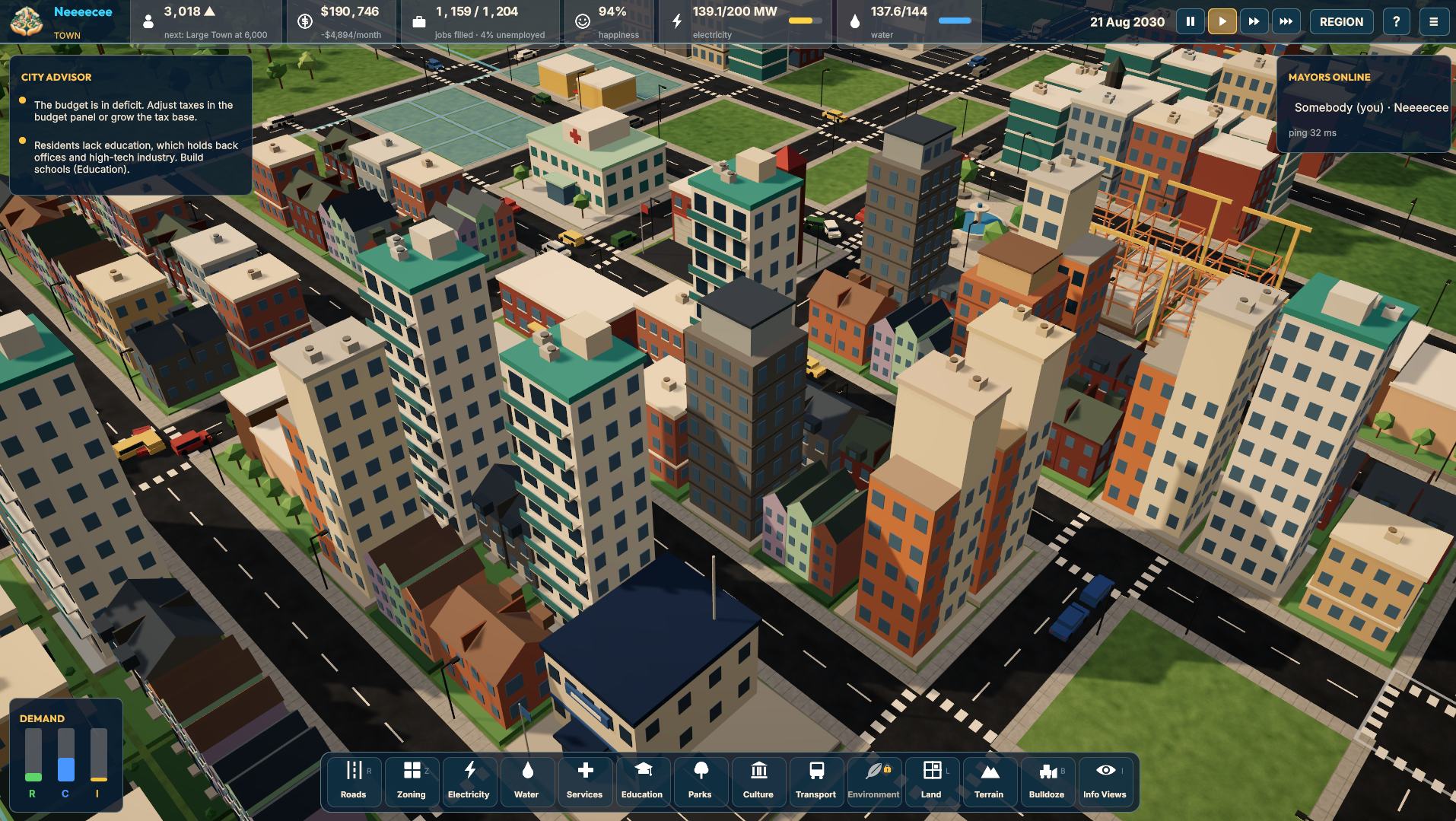
One of the most satisfying parts of building HAND IN HAND so far has been watching the city slowly grow from a few simple roads and small buildings into something that actually feels urban.
Up until now, a lot of the development work has been about building the systems that make that possible.
Roads. Utilities. Traffic. Zoning. Construction. Education. Fire and police coverage.
All of those pieces had to start working together before the city could really begin to grow.
And now, for the first time, I'm starting to see what that growth can actually look like.
This is the first version of a Level 3 city.
From Small Town to Something Bigger
Earlier on, I knew I wanted HAND IN HAND to have a sense of city progression.
A tiny settlement shouldn't look or play the same way as a growing town, and a growing town shouldn't feel the same as a larger, more developed city.
I wanted players to feel like they were building toward something.
Not just placing zones and watching numbers go up, but actually seeing their city change shape as it became more successful.
That meant taller buildings, more density, and a more urban feeling overall.
Getting to this point took a lot of experimenting.
I had already been testing how zoned properties could level up, and I'd moved away from the more basic idea of all buildings advancing just because the population had reached a certain number.
Instead, I started tying growth into the systems around it.
Education mattered. Fire coverage mattered. Police coverage mattered.
As those conditions came together, it allowed neighbourhoods to keep developing instead of staying stuck at the same basic level forever.
The First Level 3 Skyline
What I really like about this stage is that the city starts to look meaningfully different.
Instead of mostly smaller houses and low-rise buildings, we're beginning to see taller apartment blocks and denser development appear throughout the city.
The roads feel busier.
The blocks feel fuller.
The whole place starts to look less like a small town and more like a proper city.
That change is important, because visual progression is a big part of what makes a city builder fun.
You want to feel like your decisions are shaping something larger and more impressive over time.
And for the first time, I feel like HAND IN HAND is starting to deliver that.
Growth Needs Support
Of course, getting to Level 3 isn't just about making the buildings taller.
A bigger city also creates bigger challenges.
As the population grows, so do the demands on the city.
You need enough power.
You need enough water.
You need roads that can handle more traffic.
You need education and services if you want neighbourhoods to keep improving.
That's one of the things I like about how the systems are starting to connect.
The city doesn't just get bigger for free.
If you want more advanced development, you have to build a place that can actually support it.
That makes growth feel earned.
Starting to See the Goal
This first Level 3 city feels like an important step because it gives me a clearer picture of what HAND IN HAND can become.
In the beginning, I was mostly trying to prove that the basic systems could work at all.
Now I'm getting glimpses of the larger goal — a city that actually evolves, densifies, and begins to feel alive as it grows.
There's still a lot to refine, of course.
The progression systems will keep changing. The balancing will need work. And I'm sure the buildings themselves will continue evolving too.
But this is the first moment where I can really look at the city and think:
Yeah, this is starting to become something.
And that's a pretty good feeling.