
With zoning, construction, and population growth starting to work, I began thinking about what would happen as a town got bigger.
One of the things I've always enjoyed about city builders is watching a small settlement gradually transform into a larger, more developed city.
I wanted HAND IN HAND to have that same sense of progression.
But how should buildings actually grow?
Bigger Town, Bigger Buildings?
In the earliest versions, I had three main types of zoning: residential, commercial, and industrial.
Each zone type had three development levels.
Level 1, Level 2, and Level 3.
My first attempt at making those buildings advance was pretty straightforward.
I tied their development directly to the size of the town.
Once your population reached 5,000 residents, your zoned buildings would advance to Level 2. Reach 50,000 residents, and they'd advance to Level 3.
Simple enough.
And technically, it worked.
The problem was that it was kind of boring.
You'd reach a population milestone, and suddenly buildings across your city would change into their next-level models.
There wasn't much strategy involved. You just had to keep growing your population and wait for the magic number.
It also wasn't really what I'd originally envisioned for the game's progression.
Unlocking More Than Just Buildings
One of my early ideas was that reaching different town sizes would unlock new things for players to build.
As your little settlement grew into a town and eventually a city, you'd gain access to additional services and facilities.
Schools, cultural buildings, and other infrastructure would become available as your population increased.
I liked that idea because it gave players something to work toward.
But it also got me thinking.
What if those new facilities actually helped determine how your zoned buildings developed?
Instead of having every house automatically upgrade when the population hit a certain number, what if there were other conditions that had to be met?
That seemed a lot more interesting.
Time to Send Everyone to School
The first system I decided to experiment with was education.
Originally, I'd only added a single school building to the game.
But once I started thinking about education as part of the zoning progression system, it became obvious that I needed to expand on that.
So I split education into two facilities:
- School
- High School
Then I introduced a coverage radius for each one.
A school wouldn't simply improve the entire city just because you built it somewhere. Instead, it would serve the surrounding neighbourhood within its coverage area.
Now I had something I could actually use as a condition for development.
For an early test, I changed residential progression so that a building could advance from Level 1 to Level 2 when two conditions were met:
The town had reached 500 residents, and the building was within the coverage area of an educational facility.
Suddenly, things became a lot more interesting.
A neighbourhood with access to education could begin developing, while another neighbourhood without that coverage might remain at a lower level.
Players now had a reason to think about where they placed their schools instead of simply dropping one wherever there happened to be some empty land.
A Better Way to Grow
The more I experimented with this approach, the more I liked it.
Instead of tying everything to a single population number, I could start connecting different parts of the city simulation.
Population would still matter, but so would the services and infrastructure supporting the people living there.
It opened up all sorts of possibilities.
Maybe one neighbourhood develops faster because it has better services. Maybe another area needs more investment before its buildings can advance.
And most importantly, it gives players decisions to make.
Do you spend money expanding your road network and zoning more land, or do you improve your existing neighbourhoods so they can grow into something bigger?
That's a much more interesting question than simply waiting for the population counter to reach the next number.
Watching the Neighbourhood Change
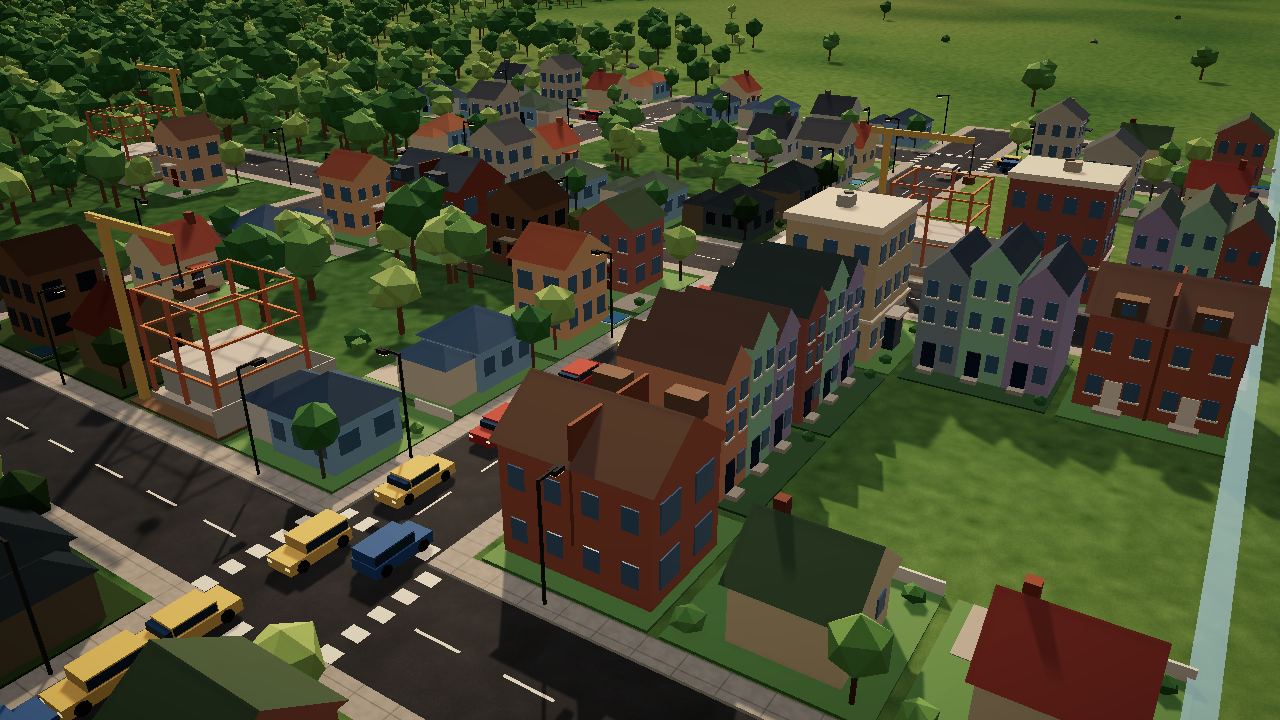
The screenshot from this stage of development shows some of the early Level 2 residential buildings.
Instead of just small houses, we're starting to see larger homes and attached townhouses appearing around the neighbourhood.
There's still construction happening, too, with the scaffolding system from the previous devlog showing where new buildings are on the way.
It's beginning to look like a town that's actually growing and changing.
I'm still experimenting with the exact conditions for building progression, and I'm sure the system will continue to evolve.
But I think this is a much better direction for HAND IN HAND.
Growing a city shouldn't just be about how many people live there. It should also be about what kind of city you're building for them.
And apparently, the first step toward a better neighbourhood is making sure the kids have somewhere to go to school.