
With the early versions of HAND IN HAND starting to take shape, I realized pretty quickly that part of the fun of a city builder is watching your city grow and change over time.
From the very beginning, one of the core ideas that stayed consistent in HAND IN HAND was the use of zoned areas — residential, commercial, and industrial. Those three zone types were always meant to be the foundation of how a city develops.
But I didn't want those zones to feel static.
I wanted them to grow.
Watching a City Evolve
A big part of the satisfaction in a city builder comes from seeing a small neighbourhood turn into something bigger and more developed as the city advances.
So I started experimenting with systems that would allow zoned buildings to level up over time.
If certain criteria were met, a zoned property could progress from Level 1 to Level 2, and later beyond that. When it changed levels, the building model could also change, making the city look more varied, more alive, and more interesting to build.
That was important to me, because I didn't want a city to look exactly the same from the moment it was placed to the end of the game.
I wanted growth to be visible.
The Problem With Things Just Appearing
Even with those early systems in place, I ran into another issue.
Buildings were just sort of… appearing.
Technically, it worked. The zone would develop, and a building would show up.
But it wasn't very satisfying.
More importantly, it didn't really make much sense.
Cities don't work like that. Buildings don't just pop into existence fully formed. And from a gameplay perspective, it took away some of the fun of anticipating what was about to happen in a neighbourhood.
So I started thinking about how to make that process feel a little more alive.
Enter the Scaffolding
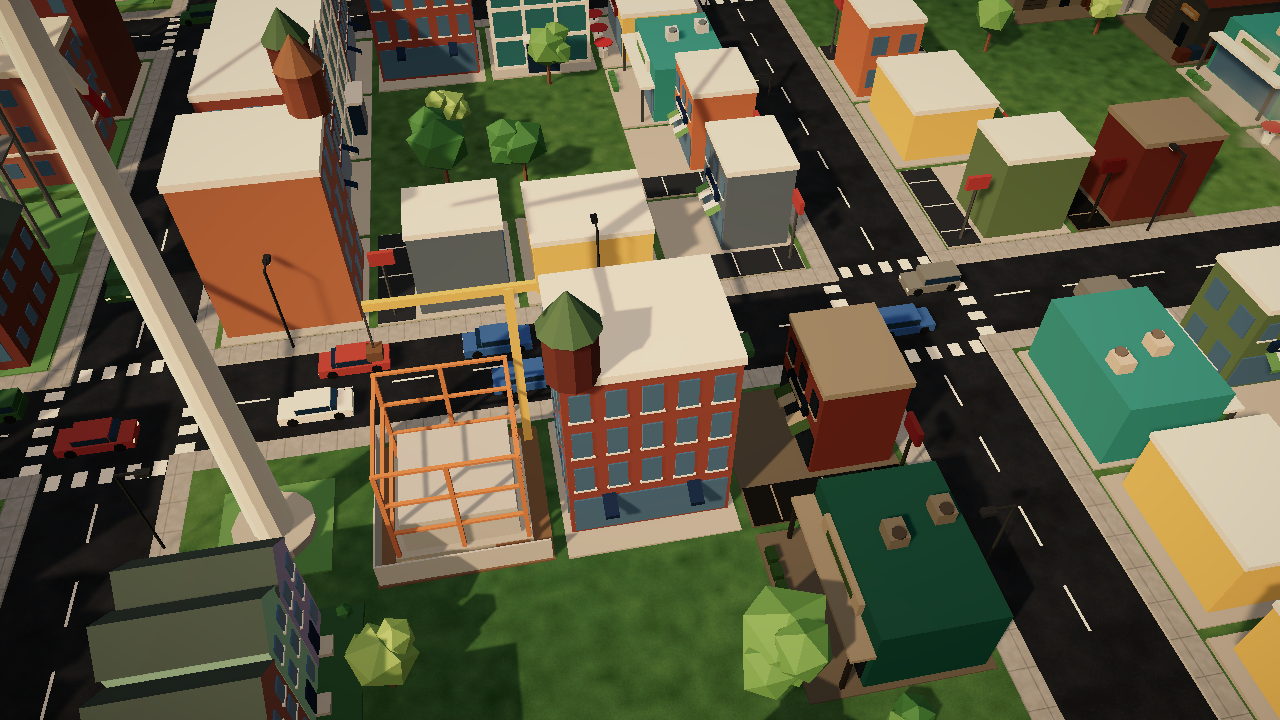
That's when I built a small scaffolding construction stage for zoned properties.
Instead of a finished building instantly appearing, a newly developing property would first enter a simple construction phase. A small scaffold structure would appear, showing that something was being built.
I added this across all three main zone types:
- Residential
- Commercial
- Industrial
It was a small feature, but it made a big difference.
Suddenly, development felt like it had a beginning.
You could look at a lot and immediately know that something was on the way.
It gave the city a sense of motion and expectation — a little signal that growth was happening.
A Small Touch That Made the City Feel More Alive
Looking back, this was one of those little systems that added a lot more personality than I expected.
The scaffolding didn't just make the process more logical — it also made it more fun.
Instead of buildings appearing out of nowhere, the city now had a visible development step that players could actually watch unfold.
It made zoning feel more like a living process, and less like flipping a switch.
And that was exactly the direction I wanted HAND IN HAND to keep moving in.
Because a city builder isn't just about placing roads and zones.
It's about seeing something small slowly become something bigger.
And this was one of the first steps toward making that growth visible.