
There's something I've been discovering as HAND IN HAND gets bigger.
The larger your city becomes, the harder it is to keep track of everything that's happening.
When you've got a little village with a few hundred residents, it's pretty easy to see what's going on.
You can look around the map, check your buildings, and generally figure out what needs attention.
But what happens when you've got 100,000 people?
Or several developed municipalities across an entire region?
Suddenly, keeping track of everything becomes a much bigger challenge.
So I've been spending some time improving the way the game communicates with the player.
And I'm pretty happy with how it's turning out.
The City Advisor Gets an Upgrade
I actually introduced the City Advisor fairly early in development.
Originally, it was a pretty simple system.
It would give you general tips about playing the game.
Build some roads.
Make sure you have electricity.
Don't forget about water.
That sort of thing.
Useful enough when you're first starting, but not necessarily the most valuable information once your town gets larger.
Over the last month and a half, I've been changing how the Advisor works.
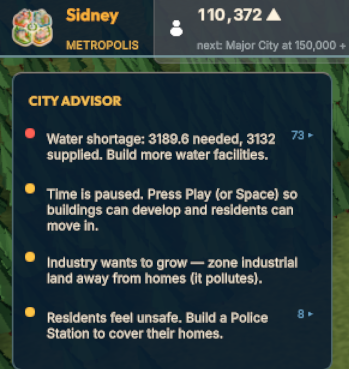
Instead of simply offering generic tips, I want it to identify actual problems happening in your city.
For example, if your municipality is running a monthly deficit, the Advisor can tell you that your budget needs attention.
If you're running short of electricity, it can warn you that buildings aren't receiving enough power.
The same goes for water.
Instead of just reminding you that water infrastructure exists, it can tell you that your city doesn't have enough supply for its current needs.
It can also point out things like missing service coverage and demand for additional zoning.
That's a much more useful way to handle it.
What Needs My Attention?
The idea behind the City Advisor is fairly straightforward.
It's there to help you understand the bigger picture.
Not necessarily every little thing happening in the simulation, but the important ongoing issues that could affect how your municipality develops.
If residents aren't receiving police protection, that's something you might want to fix.
If industry needs more room to grow, the Advisor can bring that to your attention.
If your water demand is greater than your supply, you probably need to know about it before half the town starts complaining.
And if you're losing money every month, that's worth looking into as well.
I'm trying to make the Advisor more useful as cities grow, rather than having it repeat the same beginner tips forever.
But there's another problem I've been thinking about.
What about all the things happening in the city that aren't ongoing problems?
What about the actual events?
Something Just Happened!
This led me to start working on a second system.
Notifications.
The City Advisor tells you what needs attention.
The notification system tells you what's happening right now.
And there's quite a lot happening!
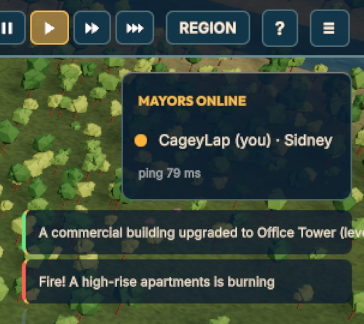
Buildings are upgrading.
Fires are breaking out.
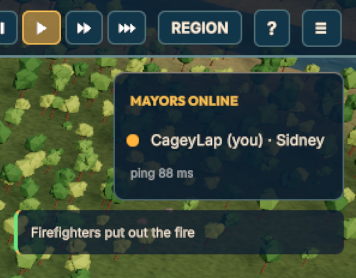
Firefighters are putting those fires out.
Cultural facilities are hosting events.
As the simulation grows, there are more and more little moments taking place across the city.
Previously, you might not even notice some of them unless you happened to be watching the right part of the map.
So I started putting together a notification system that reports these events as they happen.
A residential or commercial building advances to another development level?
A notification appears.
A building catches fire?
You get a warning.
The firetruck reaches the building and puts the fire out?
Another notification lets you know.
A concert or other cultural event attracts a crowd?
The game can tell you about that too.
It's a fairly simple idea, but it makes a surprisingly big difference.
The City Feels More Alive
One of the things I've talked about quite a bit while developing HAND IN HAND is how important movement is to making the city feel alive.
Cars moving around.
Buses carrying passengers.
Firetrucks responding to emergencies.
All those things help make the city feel like a real place instead of a collection of buildings.
And I'm discovering that notifications do something similar.
You might be working on expanding a residential neighbourhood when a notification appears telling you that a commercial building on the other side of town has upgraded.
Or maybe a fire has just started somewhere.
Suddenly, you're reminded that the rest of the city is still doing its thing.
Even when you're not looking.
I really like that.
The world feels more active.
And the feedback from the people testing the game has been pretty positive too.
But Where Is the Fire?
Of course, adding notifications created another little problem.
Let's say you're managing a city with 100,000 residents.
You've got a whole bunch of developed parcels, several neighbourhoods, industrial areas, and buildings spread across the map.
Then a notification appears.
Fire! A high-rise apartment is burning.
Okay.
That's useful information.
But where?
You could start moving the camera around, looking for the building.
Or you could try to figure out which part of the city the notification is talking about.
Neither option is particularly convenient when you're dealing with a large region.
So I've added another feature that I think makes the whole notification system considerably more useful.
Click It and Go There!
Now, when a notification refers to a specific location, you can click it.
And the game camera moves directly to where the event is happening.
A fire breaks out?
Click the notification, and the camera takes you to the burning building.
A building upgrades?
Click the notification, and you can go see the newly developed property.
It's a fairly small addition, but after testing it this week, I think it's one of the better usability improvements I've made.
Instead of telling the player that something happened and leaving them to find it, the game can take them straight there.
And as the cities get bigger, that becomes increasingly important.
The reaction from the people testing it has been encouraging.
Everybody seems to like being able to jump directly to the action.
Especially when there's a fire!
Two Systems Working Together
What I like most is that the City Advisor and the notification system have two different jobs.
The City Advisor is concerned with the ongoing state of your municipality.
It helps answer questions like:
Why isn't my city growing?
Am I producing enough electricity?
Do I need more water?
Are residents missing important services?
Am I spending more money than I'm making?
The notification system is about individual events.
A building has upgraded.
A fire has started.
Firefighters have extinguished it.
A concert has attracted visitors.
And when those events have a location, you can click to go and see what's happening.
Together, the two systems make the city much easier to manage.
And that's important because there's a lot more happening in HAND IN HAND now than there was when I first started building it.
Making the Game Easier for New Players
There's another benefit to all of this that I think is becoming increasingly important.
Not everybody who plays HAND IN HAND is going to have spent years playing city builders.
Some people might be trying this kind of game for the first time.
And I really don't want them to feel lost.
We've got zoning, education, services, budgets, pollution, transportation, culture, tourism, land ownership, and multiplayer cooperation.
That's a lot of systems to learn.
The City Advisor can help players understand what needs attention without requiring them to already know every mechanic.
And notifications make it easier to follow what's happening without constantly checking individual buildings or staring at statistics.
I want the game to have enough depth that experienced city-builder players find it interesting.
But I also want somebody who's never played one before to be able to jump in with friends and have a good time.
If these tools help make that possible, then they're doing exactly what I want them to do.
A Little More Polish
I've been testing the new notification features over the last week, and I'm really happy with how they're shaping up.
The City Advisor is becoming much more useful.
The notification system gives players live feedback about what's happening around their city.
And being able to click a notification to jump directly to an event makes the whole thing considerably easier to use.
There's still plenty of tweaking and polishing to do.
There always is.
But I think these systems are becoming an important part of making HAND IN HAND approachable as the cities get larger and more complicated.
Because building a successful city is challenging enough.
You shouldn't have to search the entire map just to find out where the fire is!