
Well, that didn't take long.
Just a few days ago, I was talking about completely changing the direction of HAND IN HAND by having players start with their own towns instead of everybody building in one shared city.
I've started putting that new system together, and we're already running into some interesting problems.
But first, the good news.
You can now found your own town!
A Little Piece of the Region
The first step was figuring out how players would actually start a game under the new system.
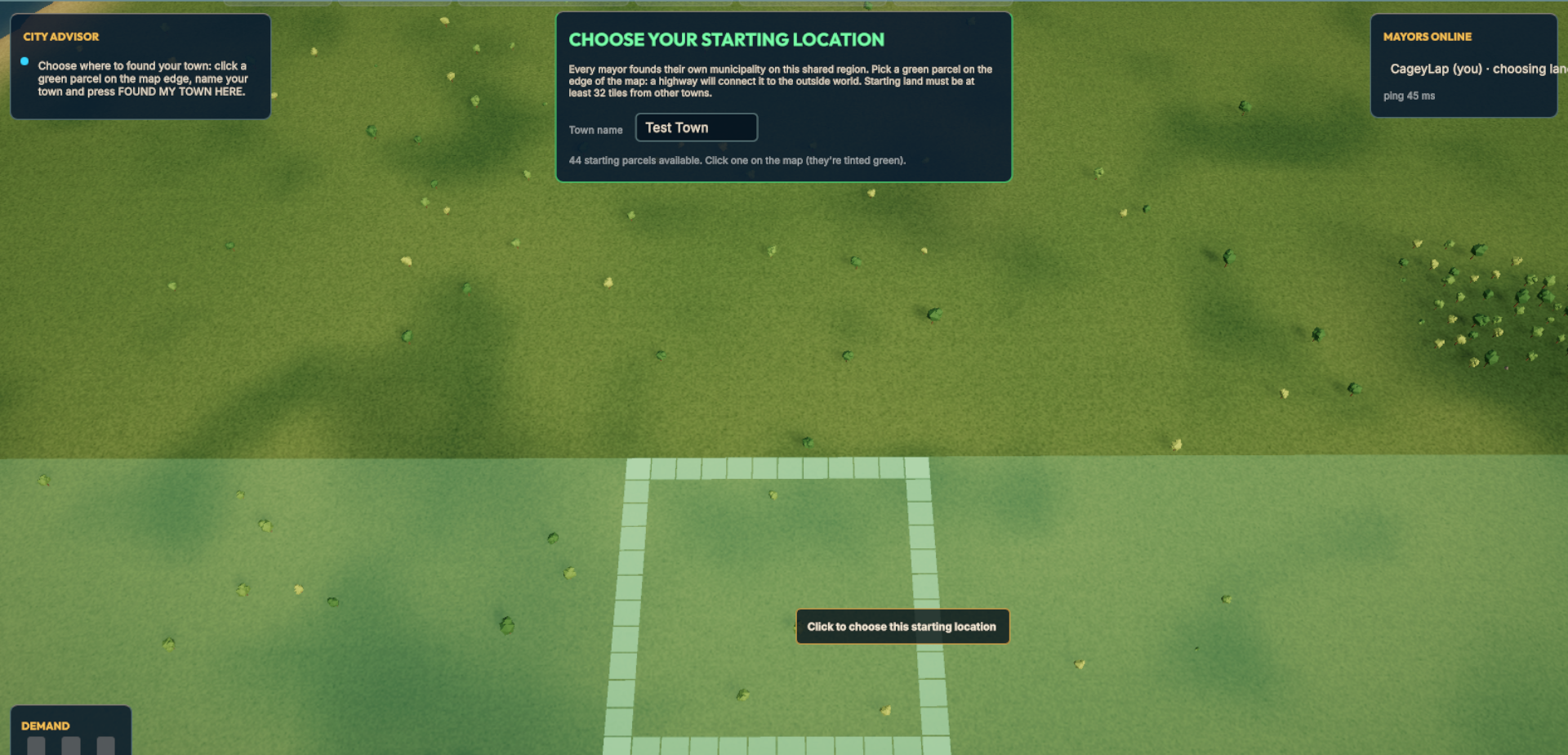
Rather than giving everyone access to the entire map, each mayor now chooses their own starting location within the shared region.
The region is still our 144 × 144 tile map, but I've divided the available land into smaller parcels.
Each starting parcel is 12 × 12 tiles.
When you join a region, you choose an available location, give your town a name, and claim your first piece of land.
That becomes your municipality.
You can build roads, zone land, and develop your town within the territory you own.
And perhaps most importantly, other players can't build on your land, and you can't build on theirs.
This is a pretty significant change from how HAND IN HAND worked just a week ago.
Everyone is still playing in the same region, but now each mayor has somewhere to call their own.
Getting Connected
There's another important part of choosing your starting location.
Your town needs access to the outside world.
I'd already been experimenting with highway connections as a way to handle goods and services moving into and out of a city.
With the new system, I've tied that connection directly to founding a town.
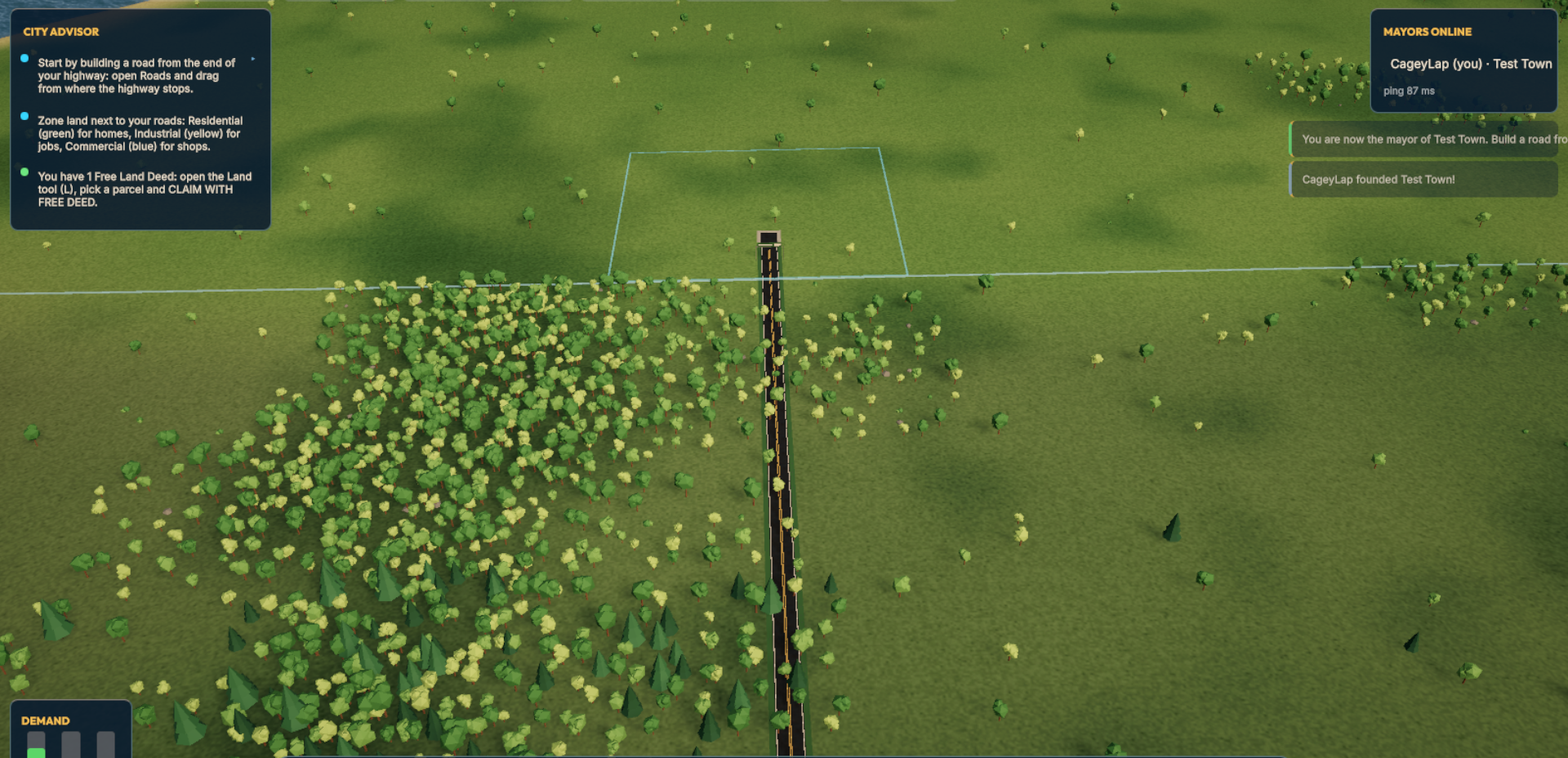
Players choose a starting parcel along the edge of the region, and once the town is founded, a highway connection is created between the outside of the map and their starting land.
From there, you can begin building your road network and connecting your first neighbourhoods.
It gives every new town a proper starting point.
And for the first time, you can look across the region and imagine several different towns growing independently, each with its own highway connection and territory.
So far, so good.
Twelve Squares Isn't Very Much
Of course, as soon as I started actually playing with the new system, I discovered a problem.
A 12 × 12 parcel is really small.
Especially when you're trying to build a functioning town.
You need somewhere for people to live.
You need commercial buildings.
And you need industry to provide jobs.
The trouble is that industry produces pollution.
In the original shared-city design, you had plenty of space to separate your industrial areas from your residential neighbourhoods.
But when you only have a single 12 × 12 parcel to work with, that's a lot harder.
No matter how I arranged things, industrial pollution seemed to end up affecting my residential areas.
It made getting a new town started unnecessarily difficult.
I could have just made the starting parcels bigger, but I actually liked the idea of having smaller parcels that players gradually acquire as their towns grow.
So I started thinking about another way to solve the problem.
Introducing Free Land Deeds
My first thought was to simply give players more starting money so they could purchase additional land.
But that didn't really feel like the right solution.
I wanted buying land to be part of the progression system, and I didn't necessarily want players spending a big chunk of their starting budget just to get enough room to build a basic town.
Then I came up with another idea.
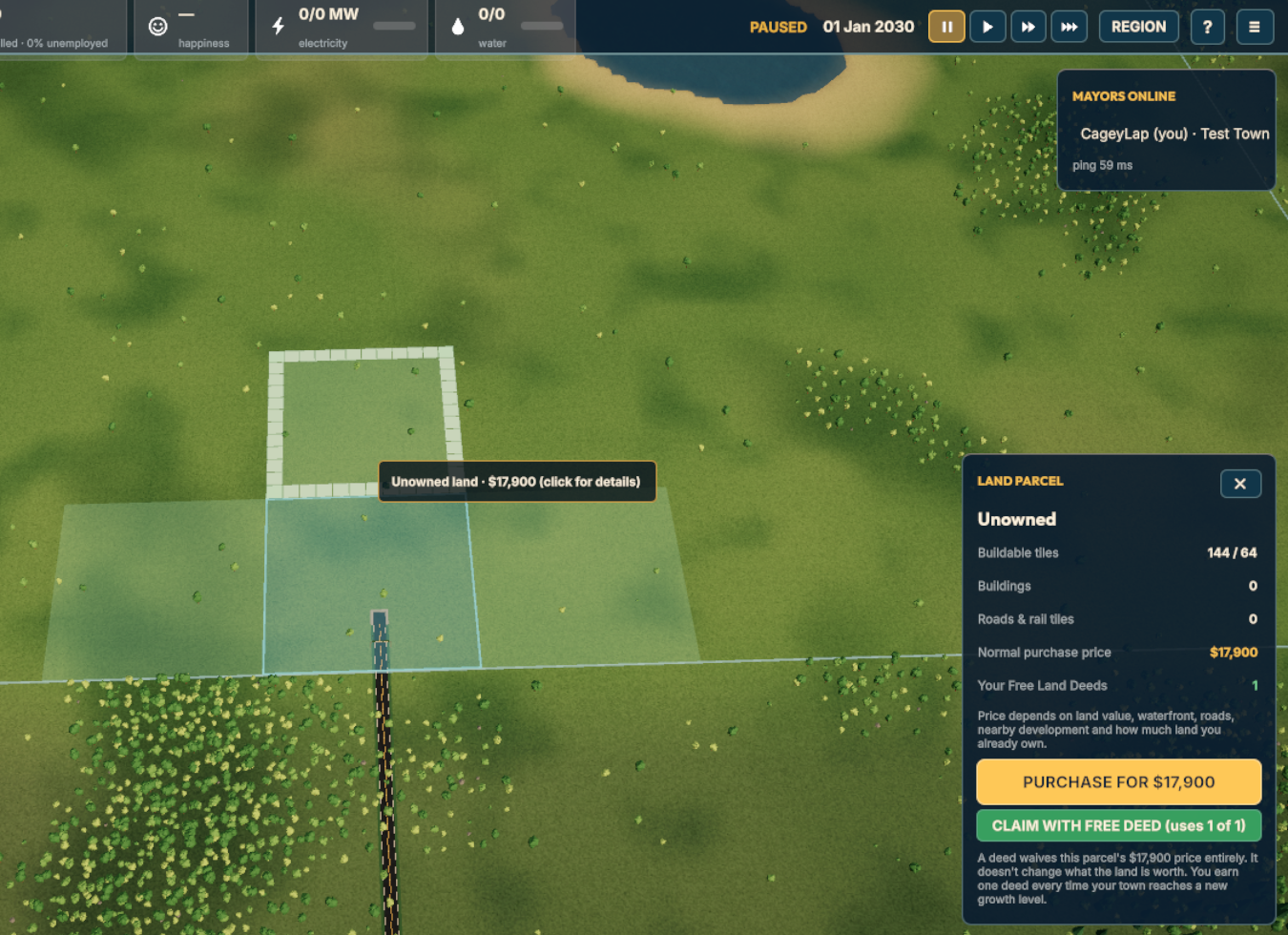
What if every new mayor received a free land deed?
When you found your town, you get your first 12 × 12 parcel.
Then you receive a free deed that allows you to claim another available parcel without paying for it.
That gives players a bit more breathing room right from the beginning.
You can start separating residential and industrial areas instead of trying to cram everything into one tiny space.
And you still have the option to purchase additional land as your town develops.
It's a pretty simple solution, but after testing it, the early results seem promising.
Rewarding Town Growth
The more I played around with free land deeds, the more I started thinking they could become part of the overall city progression system.
We've already got different town sizes and growth levels that unlock new facilities and development opportunities.
What if reaching a new town level also rewarded the mayor with another free land deed?
That would give players something else to look forward to as their population grows.
Instead of every expansion being a financial decision, some land acquisitions could be rewards for successfully developing your town.
I'm thinking that each time a town reaches a new growth level, the mayor could earn another free land deed.
That's the idea, anyway.
I still need to test how it affects the economy and whether it makes expanding too easy.
But I like the direction it's heading.
A Better Starting Point
The early tests are encouraging.
Being able to claim a second parcel immediately makes it much easier to separate industrial development from residential neighbourhoods.
It gives players a little more freedom to plan their town without removing the land ownership system I've just introduced.
And that's important, because I want expanding your territory to feel meaningful.
I don't want players to have unlimited space right from the beginning, but I also don't want the first few minutes of the game to be frustrating because you can't fit everything into your starting area.
It's another one of those situations where something sounds perfectly reasonable on paper, and then you actually play it and discover why it doesn't quite work.
Four days into rebuilding the cooperative system, we've already got independent towns, land ownership, highway connections, and now free land deeds.
There's still a lot to figure out, especially when these growing towns eventually start reaching one another.
But at least now everyone has enough room to get started.
And hopefully, somewhere to put their factories that isn't right next to their houses.