
With the first version of HAND IN HAND starting to come together, I had another decision to make.
How was I going to handle utilities?
If you've played city builders, you're probably familiar with the routine. You build a power plant, run power lines to your neighbourhoods, lay water pipes underground, and eventually spend a fair amount of time trying to figure out why that one building in the middle of your city somehow has no electricity.
Most city builders have some variation of these systems, so naturally, that's where I started.
I experimented with a few different approaches to power distribution and water networks. I tried different ways of connecting buildings and getting utilities where they needed to go.
But the more I played around with it, the more I realized something.
I didn't really enjoy it.
Keeping Things Simple
One of the things I wanted to accomplish with HAND IN HAND was to keep the actual city-building experience straightforward.
I wanted players spending their time designing neighbourhoods, building roads, developing their cities, and working together — not constantly switching between underground pipe views and overhead electrical networks.
And honestly, I wanted a cleaner map.
So I decided to try something different.
What if the roads themselves carried the utilities?
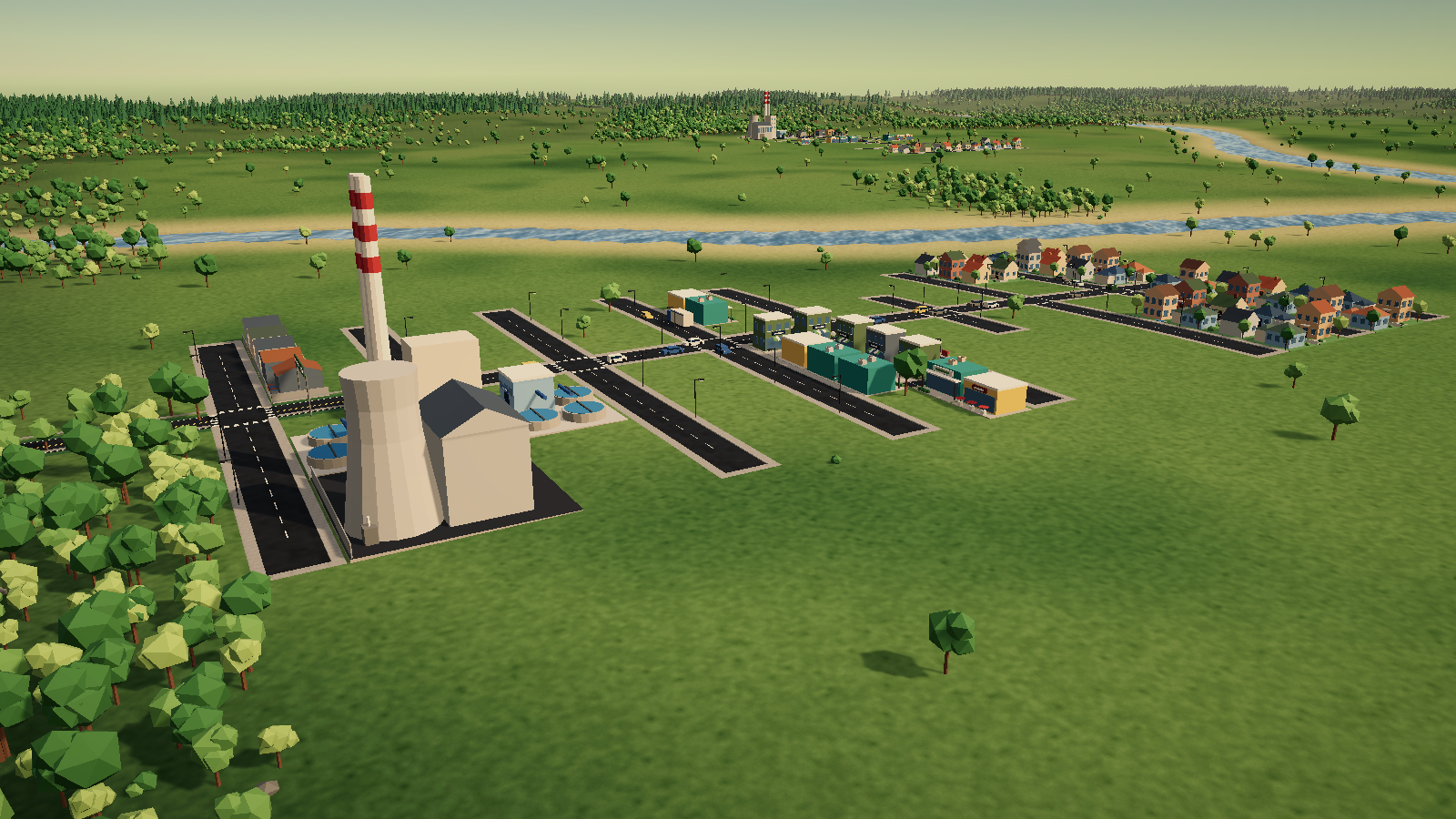
Instead of having separate power lines and water pipes to manage, I designed the road system so that every road would be a simple, two-lane road carrying both electricity and water.
Every building and every zone would need a road connection to receive those services.
That was it.
No manually drawing power lines across the map. No digging around with underground pipes.
Build the road network, connect your buildings, and let the utilities follow.
Of course, you still need to generate electricity and supply water. But distributing those services becomes part of the road network you're already building.
It made sense to me, and after experimenting with the alternatives, it felt like a better fit for the kind of game I wanted HAND IN HAND to be.
The First Power Plant
With the utility distribution system taking shape, it was time to actually generate some electricity.
And what better place to start than with one of the oldest and dirtiest ways of doing it?
Coal power.
By modern standards, coal is one of the most polluting ways to generate electricity, but it felt like a natural starting point for the game's power generation.
I started experimenting with designs using Meshy and Blender, trying to come up with something that looked like a proper industrial power station.
I went through a few different models before settling on the one you see here.
It has the big cooling towers, the industrial structures, and the smokestack you'd expect from a traditional coal-fired power plant.
Nothing particularly fancy, but for an early version of the game, I thought it did the job.
And just like that, HAND IN HAND had its first power plant.
Building the Foundations
Looking back, the decision to run utilities through roads was one of those early choices that helped define how I wanted the game to play.
Not every system needs to be complicated just because other games make it complicated.
Sometimes simplifying something can make the whole experience more enjoyable.
There's still plenty to figure out, of course. Power generation, water supply, pollution, and how all of those systems affect a growing city will need more work as development continues.
But for now, we've got roads, we've got electricity, and we've got our first power plant.
We're officially in the power business.
Unfortunately, it's coal. So maybe don't open your windows just yet.